A New Front in a Familiar Conflict
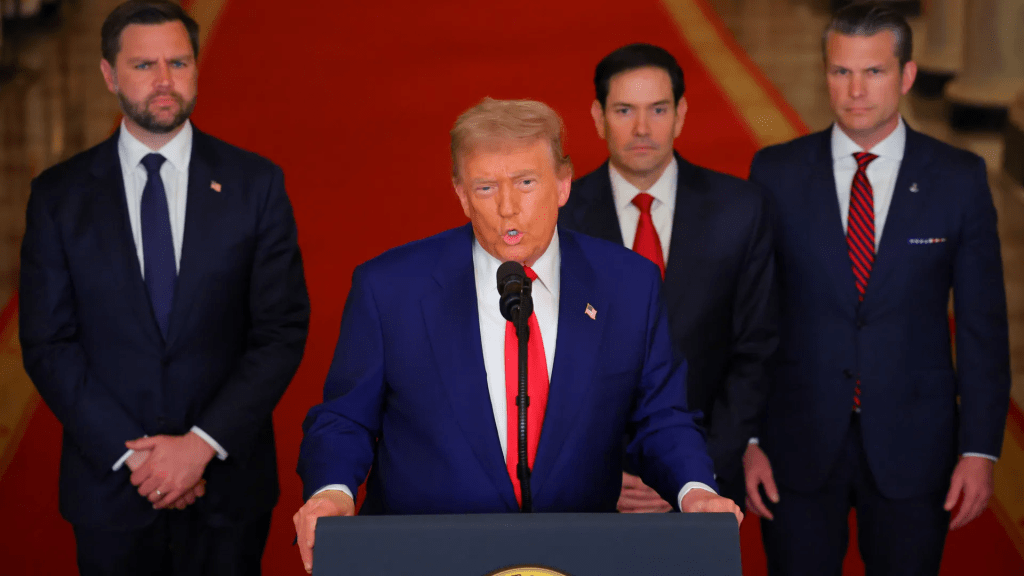
Today is a serious day for US History, President Donald Trump announced that the United States had conducted coordinated airstrikes on three of Iran’s most sensitive nuclear sites: Fordow, Natanz, and Esfahan. The attack, launched using B-2 stealth bombers equipped with bunker-busting munitions, marked the most direct U.S. military intervention against Iran’s nuclear program in decades. As explosions lit up the skies above Tehran and reverberated across global markets, the United States formally entered a rapidly escalating Middle Eastern conflict alongside Israel. Trump announced it on social media saying, “Now is the time for peace.” Whether peace follows remains uncertain, but it is sure the whole nation is watching.
How the Israel-Iran War Began
The roots of the current war trace back to escalating tensions over Iran’s nuclear program. Israel has long viewed Iran’s nuclear ambitions as an existential threat, and intelligence officials claimed that Tehran was closer than ever to acquiring a nuclear weapon. In mid-June, Israel launched a series of surprise airstrikes on Iranian territory, targeting key military and nuclear infrastructure. Iran responded with hundreds of missile and drone attacks on Israeli cities, prompting mass evacuations and international alarm.
What began as a regional conflict soon grew into a crisis with global implications. Iran’s network of proxy forces in Iraq, Syria, Lebanon, and Yemen have also stirred regional instability. Calls for de-escalation have echoed across the United Nations, but diplomacy remains on the sidelines as military engagement deepens.
A Calculated Decision with Global Ramifications
The decision to strike came after a prolonged diplomatic impasse and days of speculation. Trump, whose social media posts alternated between calls for peace and aggressive rhetoric, stated that the attack was necessary to dismantle Iran’s nuclear capability and restore American credibility on the global stage. According to administration sources, the president hopes the strikes will compel Iran to return to negotiations. But Iran has promised retaliation, and so far, both sides have shown little inclination to back down.
In the days leading up to the strike, Iran launched more than 400 ballistic missiles toward Israel. In response, Israel intensified its military campaign, striking Iranian command structures and killing senior military officials. The strikes by the U.S. significantly expand the scope of the conflict and introduce new risks, particularly for American forces and civilians across the region.
Why This Matters for Florida
While the airstrikes occurred halfway across the globe, their consequences are being felt at home, especially in Florida. As a state with deep military roots, multiple bases, and a large population of veterans, Florida finds itself uniquely exposed to the fallout of renewed military engagement in the Middle East.
To start, there are immediate economic concerns. Florida’s economy is heavily reliant on tourism and transportation. These are much at risk if war occurs. The price of oil surged following the strikes, driving up fuel costs and threatening to slow Florida’s post-pandemic recovery. The Port of Miami and Port Tampa Bay are particularly susceptible to disruption in global shipping lanes, especially if the Strait of Hormuz is affected.
Second, there are military implications. Florida is home to CENTCOM at MacDill Air Force Base in Tampa, which oversees U.S. military operations in the Middle East. Any escalation involving American personnel will likely be coordinated through this command. If the conflict expands, Florida’s military infrastructure could be drawn further into the planning and execution of operations, with potential deployments affecting thousands of service members and their families.
Lastly, the growing Iranian threat of retaliation against U.S. forces abroad has direct implications for Floridians. With thousands of troops stationed in vulnerable bases across the Middle East, any strike against American personnel could trigger broader military involvement, raising the specter of prolonged warfare. Florida families with loved ones in uniform face renewed uncertainty.
A Deepening Divide at Home
The strikes have also reignited political tensions across the United States. In Congress, lawmakers from both parties have expressed concern over the lack of congressional authorization for the use of force. Critics argue that Trump’s actions risk plunging the U.S. into another prolonged conflict without a clear exit strategy. In Florida, a politically diverse and increasingly divided electorate is watching closely. For communities with strong ties to the military and for voters concerned about economic stability, the strikes may redefine how national security is discussed ahead of the 2026 elections.
The Price of Power
President Trump’s decision to strike Iran has placed the United States on a precipice. What was once a distant conflict is now one with tangible consequences for our economy, our service members, and our national security. Florida, with its strategic importance and vulnerable position, stands at the forefront of what may become a long and volatile chapter in U.S. foreign policy. He will be addressing the nation today at 10 PM
This is not merely a foreign policy crisis. It is a defining moment for the nation’s future. This is a moment of gravity. The coming weeks will reveal whether Trump’s strategy ushers in peace or ignites a broader war. The path forward demands clarity, diplomacy, and above all, the recognition that in war, the human cost always runs deeper than the headlines. Floridians should not only pay attention, they must prepare. Stay safe America.

 Criminally Informed
Leave a comment