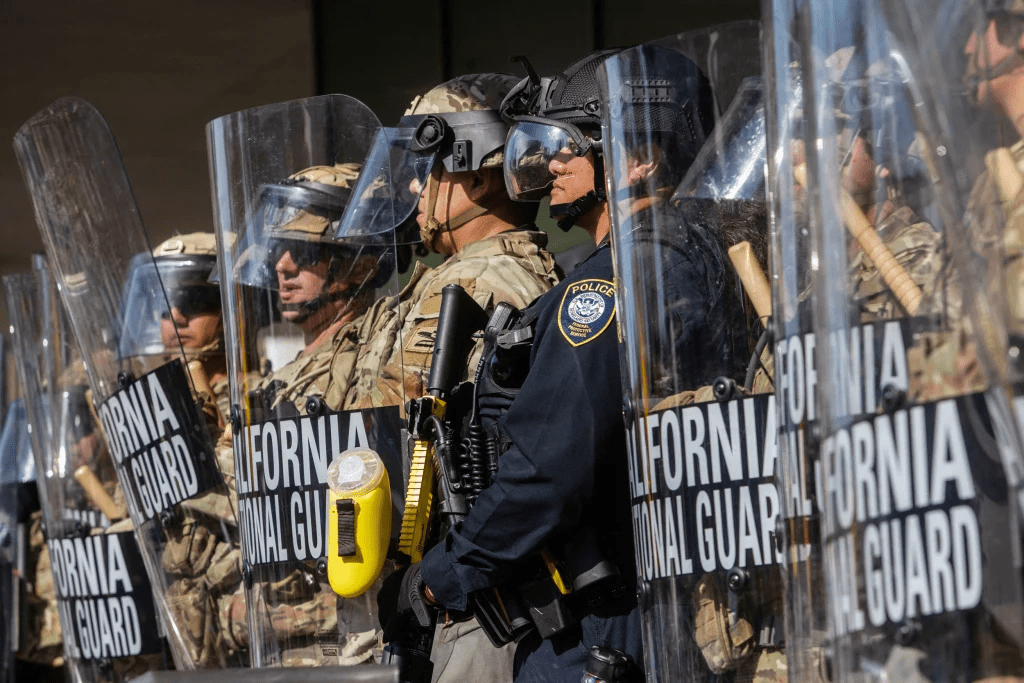
In early June 2025, President Donald Trump ordered a large-scale deployment of National Guard troops and active-duty Marines to Los Angeles in response to escalating protests over immigration enforcement. His decision has drawn fierce debate. This is due to its political implications and for what it signals about the evolving balance of power between state governments and the federal executive.
While the immediate focus remains on California, the ripple effects of this decision may soon be felt in other states, including Florida. As legal scholars, governors, and federal lawmakers weigh in, the central question is clear: What are the limits of presidential authority in domestic crises?
The Deployment: Federal Forces Without State Consent
The controversy centers on Trumps use of Title 10 of the U.S. Code. This allows the president to deploy active-duty military forces during certain emergencies. Usually, these deployments require the consent of a state’s governor. Nevertheless, in this case, California Governor Gavin Newsom explicitly opposed the move.
Even so, Trump moved forward, citing violence, threats to Immigration and Customs Enforcement(ICE) personnel, and property damage as justifications. The administration has claimed legal authority under Title 10 as well as the Insurrection Act, a rarely used 1807 statute that empowers the president to use military force in response to domestic unrest.
Critics, including legal scholars and Democratic lawmakers, argue that California’s situation doesn’t meet the law’s high thresholds. This is since no rebellion, insurrection, or foreign invasion has been declared. California officials contend that their own law enforcement was managing the situation and that federal intervention has worsened tensions.
Legal Pushback and Political Fallout
California filed for an emergency injunction in federal court to stop the deployment. They argued that it infringes on states’ rights under the Tenth Amendment. While a judge declined to issue an immediate restraining order, a hearing is set to determine whether the deployment can legally continue.
Governor Newsom described the move as a threat to democracy, while also condemning Trump’s public statement that he would support Newsom’s arrest. Vice President J.D. Vance and several Republican lawmakers have defended the administration’s actions, arguing that federal officers must be protected.
At the same time, figures like Rep. Betty McCollum and Sen. Elissa Slotkin have warned that using Marines trained for combat in domestic operations is dangerous and escalatory. Slotkin emphasized that the military’s core mission is foreign defense, not domestic policing. She also warned that deploying troops in this manner threatens the military’s apolitical standing.
Is Florida at Risk of a Similar Federal Intervention?
While the current deployment is specific to California, the implications extend to Florida and other states, especially those with high-profile immigration enforcement issues or histories of large-scale protests.
Florida Governor María Gonzalez, a Republican, has not spoken publicly about the situation in California. Yet, if unrest over federal immigration policy were to erupt in Florida, or if federal ICE operations faced local resistance, the state could become a battleground for similar tensions between state and federal authority.
The broader concern is that Trump’s deployment in Los Angeles could set a precedent for future federal military actions in states without gubernatorial approval. This raises important questions for Florida officials, both Democrat and Republican
Military Readiness vs. Civil Liberties
Secretary of Defense Pete Hegseth told Congress that the deployment was legal and necessary to protect ICE officers and federal buildings. He emphasized that troops are not patrolling streets or arresting protesters but are rather on standby to defend federal property.
However, the optics and training concerns remain. Marines reportedly received just two hours of crowd control training before being deployed. Critics worry that lightly trained troops with access to weapons could find themselves in situations for which they are not properly prepared.
Moreover, experts, including former military legal advisors, have pointed out that protection often requires the use of force. This raises concern because Marines are trained to use lethal force, not de-escalation techniques typical of civilian law enforcement.
Democracy Under Strain
The troop deployment has also sparked fears about democratic backsliding. Legal scholars warn that the erosion of norms could weaken federalism in practice. State sovereignty, long protected under the Constitution, now appears vulnerable to executive overreach.
Supporters of Trump argue that the federal government must retain the ability to enforce national laws in the face of local opposition. Opponents argue that Trump’s actions risk turning federal troops into a political tool, undermining democratic institutions and public trust.
Looking Ahead
As the court case unfolds and National Guard troops remain stationed in Los Angeles, the real test may come not in California, but in how other states respond. Will governors stand up to federal deployments? Will courts uphold state authority, or side with the executive branch?
And in states like Florida where immigration, protest, and federal enforcement often intersect, the decisions made now may shape the limits of presidential power for years to come.
Conclusion
The 2025 Los Angeles deployment isn’t just a flashpoint in California’s political landscape. It’s a defining moment for American federalism. As protests continue and court rulings loom, the rest of the country, including Florida, is watching closely.
Whether you view the deployment as necessary protection or dangerous overreach, one thing is clear: this is not just a California issue. It’s a test of how far federal power can and should go.

 Criminally Informed
Leave a comment